Geography 1000 Earth's Surface and Environments
Tracking Earthquakes and Volcanoes
Part One: Tracking Earthquakes
Earthquakes are the Earth's natural means of releasing stress. When the Earth's plates move against each other, stress is put on the lithosphere. When this stress is great enough, the lithosphere breaks or shifts. When the break occurs, the stress is released as energy which moves through the Earth in the form of waves, which we feel and call an earthquake. This portion of my ePortfolio tracks earthquakes along different plate boundaries. Below I have listed four earthquakes of magnitude 4.0 or greater at each plate boundary.
1. Oceanic-Oceanic
An Oceanic-oceanic convergence is when two oceanic plates
converge and one is usually subducted under the other and in the process a deep
oceanic trench is formed. Below is a current location of
an earthquake in the Aleution Islands. 

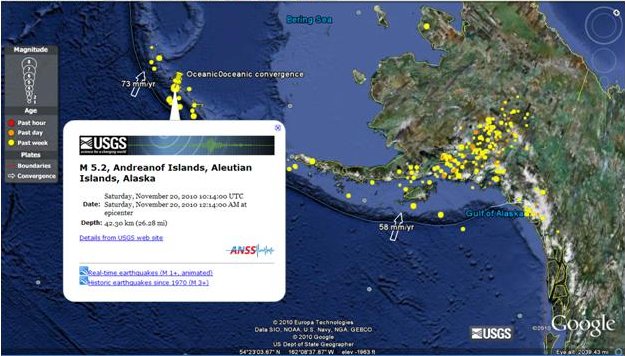
Magnitude: 5.2
Location: Aleution Islands, AK
Time: 10:14:00 UTC
2. Oceanic-Continental
Oceanic-Continental Convergence is when an oceanic plate
pushes into and subducts under a continental plate. Such earthquakes are
often accompanied by uplift of the land by as much as a few meters. The
following screenshot illustrates a current earthquake off the coast Oregon.
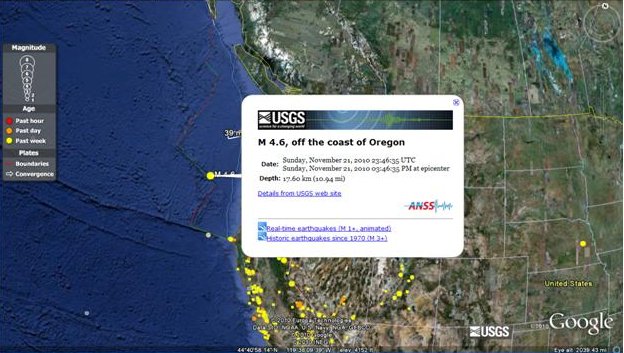
Magnitude: 4.6
43.464°N, 127.213°W
3. Continental-Continental
Continental-Continental is when two plates converge, buckle, fold and fault to form complex mountain ranges of great height.
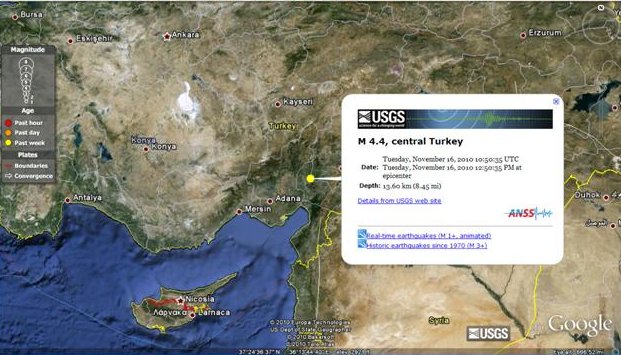
Location: Central Turkey
37.410°N, 36.229°E
Date: Tuesday Nov. 16 2010
Time: 10:50:35 UTC
Depth: 13.6 km (8.5 miles)
4. Divergent
A divergent boundary is a linear feature that exists between two tectonic plates that are moving away from each other. These areas can form on the end of continents and eventually form ocean basins, resulting in new crust being added to the surface of the earth. Divergent boundaries can also develop within a continent, resulting in a continental rift valley which is the process of the spreading of the earth’s surface. Below is an illustration of an earthquake that took place at the edge of a continent.
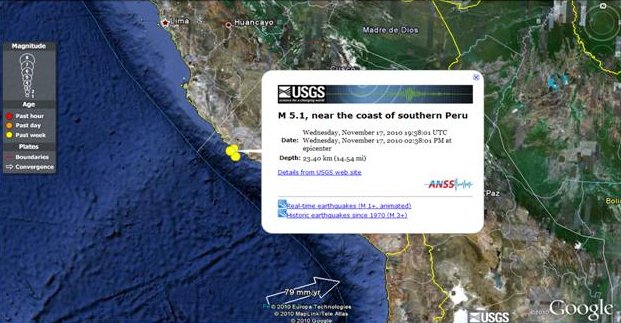
15.658°S, 74.967°W
Time: 19:38:01 UTC
Depth: 23.4 km (14.5 miles)
5. Transform
Transform-Fault Boundaries are where two plates are sliding horizontally past one another; commonly know as faults. Most transform faults are found on the ocean floor. A few, however, occur on land. Below is an image of a current earthquake.
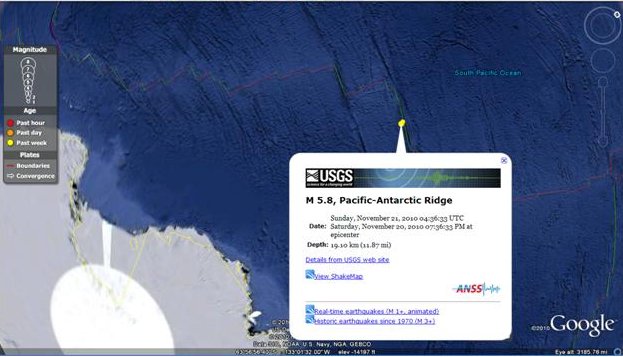
Location: Pacific-Antarctic
54.914°S, 131.402°W
Date: Sunday, Nov. 21 2010
Time: 04:36:33 UTC
Depth: 19.1 km (11.9 miles)
Part Two: Identifying Volcanoes
A volcano is an opening, or rupture, in a planet's surface or crust, which allows hot magma, volcanic ash and gases to escape from below the surface. Volcanoes are generally found where tectonic plates are diverging or converging. This portion of my eportfolio focuses on the four different types of volcanoes.
1. Oceanic-Oceanic
Oceanic volcanoes are aligned along the crest of a broad ridge that symbols an active fracture system in the oceanic crust. Volcanic rock generated in the upper mantle beneath the ridge, rise along cracks through the basaltic layer.
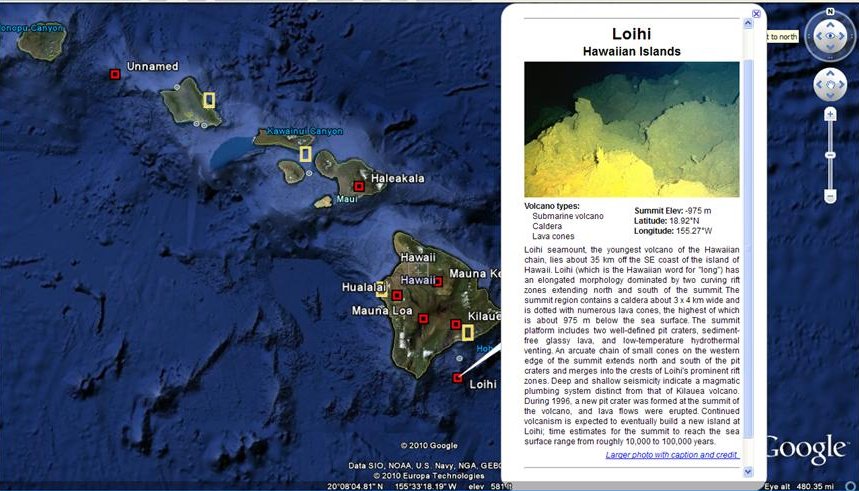
Volcano Type:
Caldera
Submarine Volcano
Lava Cones
2. Oceanic-Continental
Oceanic-Continental volcanoes are located in unstable, mountainous regions that have thick roots of granite like rock. Magmas generated near the base of the mountain, rise slowly along fractures in the crust. During course through the granite layer, magmas are commonly changed in composition and erupt on the surface to form volcanoes constructed of non-basaltic rocks.
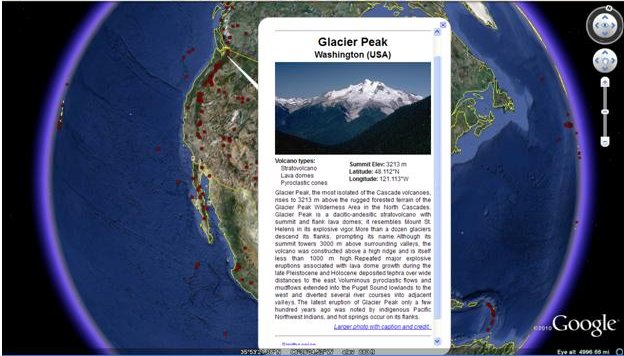
Volcano Type: Stratovolcano
Pyroclasic Conoes
3. Divergent
Divergent boundaries also form volcanic islands which occur when the plates move apart to produce gaps which molten lava rises to fill. Thus creating a shield volcano which would eventually build up to become a volcanic island. two plates move apart from each other and the space that this creates is filled with new crustal material sourced from molten magma that forms below.
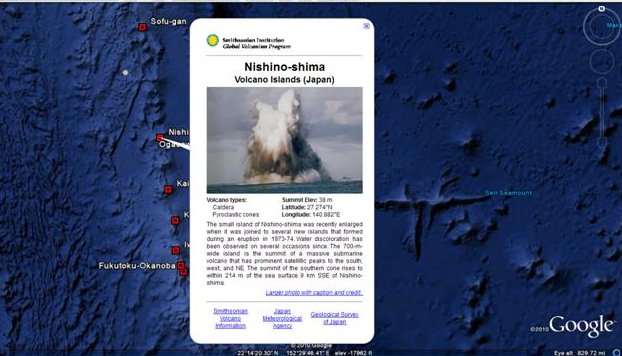
Volcano Type:
Caldera
Pyroclastic cones
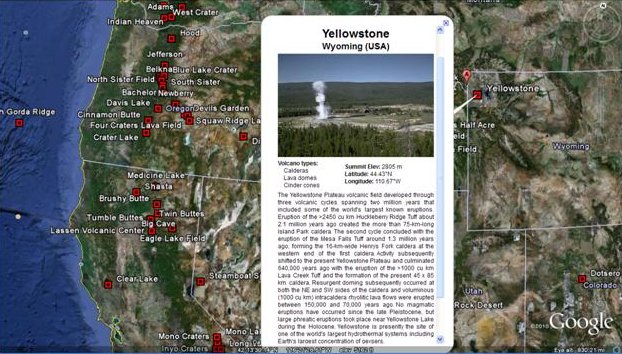
Volcano Type: Calderas
Lava domes
Cinder cones
Volcanoes and earthquakes are related in a way that is very similar. During the course of my assignment I soon realized that volcanoes and earthquakes happen in a close proximity of one another. On the Earth's surface both earthquakes and volcanoes occur at the boundaries of tectonic plates. Earthquakes are a direct result of built up pressure that is released when plates spread apart or move past one another. In the same instance, magma is generated at most plated boundaries and the magma rises to the surface to form volcanoes
During the process of my research I soon realized there were many things that I was unfamiliar with. For instance, I gained a deeper knowledge that earthquakes and volcanoes are closely related due to the theory of plate tectonics.
